Mordecai Gleister
The Robot Who Looked Like MeMordecai Gleister is the identity Emperor Mingus adopts to enter a gathering of the Gleisters, where his sudden revelation turns a political argument into a hostage crisis. His appearance briefly makes the Emperor’s rule seem open to reconsideration; his gun then exposes the force behind that invitation. The confrontation ends with Mordecai dead and Egon Gleister recognized as the prospective new Emperor, folding disguise, political power, and succession into a single reversal.
Identity and Entrance
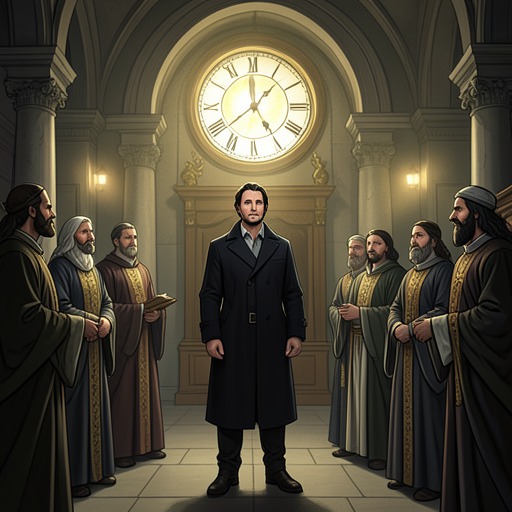
Mordecai introduces himself to the assembled Gleisters as a man with urgent matters to address. Egon, acting as chairman, invites him onto the stage. The entrance is orderly and public: Mordecai asks for permission, receives it, and begins not with a threat but with a challenge to the audience’s assumptions about the Emperor. He argues that they have treated the Emperor and his aims as evil without impartial examination. The appeal presents Mordecai, at first, as a dissenter asking the group to reconsider its settled judgment.
That identity is a disguise. Hieronymous Gleister recognizes Mordecai as the confident, bearded man in his fifties he has seen before, then realizes that the speaker is Emperor Mingus. His recognition interrupts the speech and changes the meaning of the scene: the supposed outsider inviting scrutiny of the Emperor is the Emperor himself. The book thus makes political judgment depend on a delayed act of recognition. The assembly is not debating Mingus in his absence; it is listening to him before it knows who he is.
From Argument to Coercion
Hieronymous runs toward the stage and calls on the others to seize Mordecai, identifying him as Mingus. Egon hesitates, then moves with Hieronymous, while several other Gleisters rise and climb onto the stage. Their collective response suggests the possibility of immediate resistance. It stops when Mordecai draws a blue-steel automatic from his pocket and points it at Egon. The argument has become a crisis in which the chairman’s life, and the behavior of the assembled group, are under threat.
Mordecai orders everyone except Egon and Hieronymous to resume their seats. He explains that the weapon only looks like a Colt .45 automatic: it is his, or their, invention, operates by laser diffusion, and can paralyze a person at fifteen feet before causing death seconds later if the beam remains on. This account gives the threat a precise mechanism and deadline. The weapon is not merely a symbol of authority; it is the means by which Mordecai controls the room, restrains a potential crowd, and keeps two named opponents standing apart from it.
After allowing the explanation to take effect, he addresses the gathering as his brothers and loyal subjects and announces that the Emperor Mingus greets them. The announcement completes the disguise’s transformation into public revelation. His earlier call for impartial consideration of the Emperor’s aims now carries an unmistakable irony: the person urging the Gleisters to reassess their judgment is also the ruler who has secured their obedience at gunpoint. The scene joins persuasion and coercion without treating them as alternatives. Mingus makes his case, but he also ensures that no one can safely answer it by force.
The Emperor’s Account and the Gleister Gathering
Mingus describes his rise as the result of both personal action and historical opportunity. He says that he invented a time machine and traveled to the distant future, where his experiences shaped the decisions that followed. The world he encountered, in his account, was depleted of physical and mental resources and divided into small, quarrelsome kingdoms. He took control, aided by the time machine’s extraordinary power, but also by conditions favorable to organization and his own suitability for the task. His explanation therefore presents rule as neither a simple accident of technology nor a purely personal achievement: it depends on the conjunction of his intervention, the machine, and a fractured world.
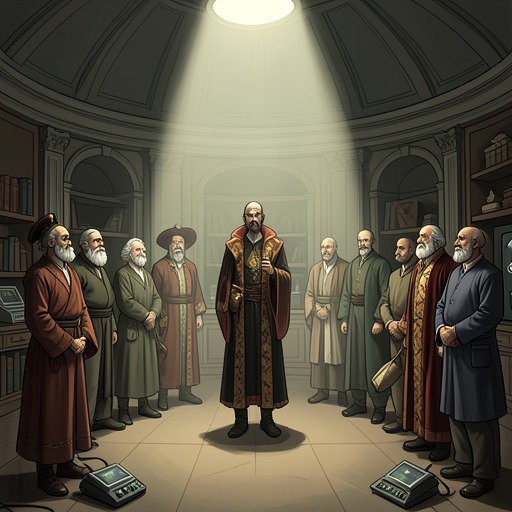
The gathering’s composition sharpens the political stakes. The Gleisters have undergone similar stresses and influences, but at different subjective moments; those differences have produced distinct emotional configurations and individuals. The assembled men may appear frightened or courageous, sociable or solitary, clever or confused, rather than a uniform body. Against this background, Mingus’s effort to address them as loyal subjects confronts a group whose shared history has not erased individual difference. Their initial movement toward the stage demonstrates that at least some are prepared to act against him, but his weapon forces the room back into silence.
Death and Succession
The final exchange centers on whether the Emperor’s place can be transferred without breaking the logic of time travel. Hieronymous urgently tells Mordecai-Mingus to give Egon the gun, reasoning that time travel requires events to be overdetermined and that there must be a second Emperor. Mordecai agrees, adding that Egon will not mind which end of the weapon he gets first. The transfer is framed as both a test of succession and a continuation of the threat that has governed the meeting.
Mordecai instead aims at Egon and pulls the trigger. The outcome reverses his apparent control: shock crosses his face, he goes rigid, and he falls. The weapon drops from his hand and clatters across the floor to rest at Hieronymous’s feet. Hieronymous picks it up, bends over Mordecai, and confirms that he is dead. The account provides no explanation for why the gun kills its holder rather than Egon, so the reversal remains a sharp break in Mordecai’s control rather than an explained mechanical failure.
Egon’s response is restrained: he observes that they seem to have a new Emperor. The remark follows the death immediately, converting the struggle over whether there must be a second ruler into an apparent change of power. Mordecai’s final significance lies in that double reversal. He arrives concealed as a Gleister and reveals himself as the Emperor; he appears to command the room and ends as its dead captive of circumstance. His death leaves the political order unsettled but supplies the gathering with a successor in Egon.